Spartathlon cut-off times, checkpoint by checkpoint
The Spartathlon allows 36 hours overall, but it checks the clock at every timing point, not only at the end. From the 2026 data: where the tightest cut-offs sit among the checkpoints we examine, the pace each stretch of the course requires, and how much margin the median runner actually had at each checkpoint.
How the cut-offs work
The Spartathlon starts on Saturday morning, at 07:00, at the Acropolis. Every runner must reach the statue of Leonidas in Sparta within 36 hours, that is by 19:00 on Sunday. Along the way, the organisers set a closing time at every checkpoint. Anyone arriving after that time is out of the race there.
The cut-offs are not one fixed pace. Each checkpoint has its own clock time, so the average pace allowed from the start changes, stretch by stretch, as the course goes on.
The cut-offs, checkpoint by checkpoint, with the pace they require
- Elefsina, km 20.1: closes at 09:10, 2:10 after the start. Required average pace from the start: 6:28 min/km.
- Megara, km 42.2: 11:40, 4:40 after the start. 6:38 min/km. Estimate: the official source gives no time here.
- Corinth Canal, km 79.8: 16:30, 9:30 after the start. 7:09 min/km.
- Ancient Nemea, km 122.7: 23:00, 16:00 after the start. 7:49 min/km.
- Sterna, km 142.6: 02:20 on Sunday, 19:20 after the start. 8:08 min/km.
- Mountain base, km 159.4: 05:10, 22:10 after the start. 8:21 min/km.
- Nestani, km 170.4: 07:30, 24:30 after the start. 8:38 min/km.
- Tegea, km 193.9: 11:10, 28:10 after the start. 8:43 min/km.
- Sparta (finish), km 244.7: 19:00, 36:00 after the start. 8:50 min/km.
Which of the 9 stretches has the tightest cut-off
The required pace is not the same on every stretch of the course. Among the 9 stretches this article compares, the tightest is the first 20.1 km, to Elefsina: 6:28 min/km over 2:10. That is the fastest required pace among the 9 stretches this article compares.
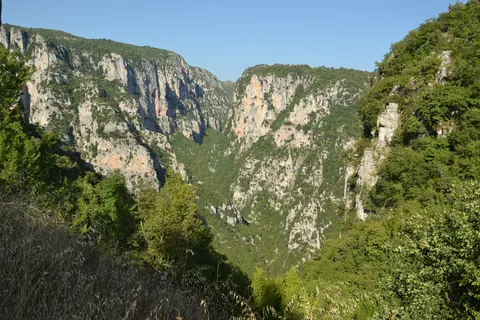
The loosest stretch, among those same 9 and in clock terms, is the 11.0 km from the mountain base to Nestani: 12:44 min/km over 2:20. That does not mean it is an easy stretch: it includes the climb to the Sangas pass and the steep descent. The organisers simply allow the most time per kilometre there of the 9 stretches compared.
How the 2026 field fared (snapshot 27/9, 19:12)
The live snapshot from Sunday 27/9 at 19:12 shows how much real margin the median runner had at each checkpoint before it closed.
- Elefsina (n=372): median margin 16 minutes, the smallest median margin across the 14 checkpoints in the snapshot. The tightest real margin among the 14 checkpoints we examine.
- Megara (n=370, estimated cut-off): median margin 34 minutes.
- Corinth Canal (n=369): median margin 77 minutes.
- Ancient Nemea (n=349): median margin 137 minutes.
- Sterna (n=338): median margin 154 minutes.
- Mountain base (n=260, fewer recorded passages than at the article’s other checkpoints): median margin 141 minutes.
- Nestani (n=301): median margin 162 minutes.
- Tegea (n=293): median margin 158 minutes.
Last recorded split among DNF rows (same snapshot)
Among the 104 rows marked DNF in the live snapshot, the last recorded split was Sterna for 26 rows, Tegea for 12, Ancient Nemea for 11, Nestani for 8, Megara for 7, the mountain base for 4 and the Corinth Canal for 1. The remaining 35 had their last recorded split at other checkpoints. These values do not show where a runner stopped or was removed, or why.
The final limit: 36 hours
Of the 380 runners with at least one recorded passage after the start, 276 have a finish time in the official table, including one recorded above 36 hours. That is 72.6%. The 380 are not the full official starter list: they are the runners with at least one passage after the start on the live clock.
Frequently asked questions
What is the tightest cut-off in the Spartathlon, among the 14 checkpoints we examine?
Elefsina, at km 20.1. In 2026 the median runner had just 16 minutes of margin before the checkpoint closed (n=372, snapshot 27/9 19:12).
Which cut-off is an estimate rather than an officially published time?
Megara's, km 42.2. The source gives 00:00 as a placeholder, so the 11:40 figure is interpolated between the neighbouring checkpoints.
Which stretch of the course has the most generous allowed pace, among the 9 stretches this article compares?
From the mountain base to Nestani, 12:44 min/km, the stretch that includes the Sangas pass.
How much time does a runner have in total?
36 hours, from the Saturday 07:00 start to 19:00 on Sunday.