Pheidippides: history vs. legend
The earliest surviving source on the episode, the historian Herodotus (born c. 484 BC, six years after the battle), describes just one run: from Athens to Sparta and back, before the Battle of Marathon in 490 BC, to ask for help. He does not mention a second run from Marathon to Athens, and no death. Both of those elements — the victory run and the death with the words "We have won!" — first appear in Plutarch (c. 100 AD, with a different runner's name) and in Lucian (2nd century AD, with the name Philippides), more than 500 years after the events, and were fused into a single narrative by Robert Browning in 1879 — the generation right before the 1896 Olympics, inspired by that story, established the modern marathon race. Below is what each source actually says, in what order, and how both halves of the story live on today in two different races.
- 490 BCPheidippides is sent from Athens to Sparta to ask for help, shortly before the Battle of Marathon (Herodotus).
- 490 BCThe Athenians, with the Plataeans, defeat the Persians at Marathon.
- c. 430-425 BCHerodotus writes the Histories — only the run to Sparta, no mention of a second run or a death.
- c. 100 ADPlutarch writes of a Marathon-to-Athens run, naming the runner as Thersippus or Eucles.
- 2nd century ADLucian attaches the run and the death to a runner named Philippides.
- 1879Robert Browning publishes the poem "Pheidippides", fusing the two narratives into one.
- 1896The first modern marathon is run at the Athens Olympics, an idea of Michel Bréal.
- 1982-1983John Foden tests the Athens-Sparta route; the first Spartathlon is run in 1983.
Who was Pheidippides
According to Herodotus, Pheidippides was an Athenian hemerodromos — a professional long-distance runner-messenger. In 490 BC, with the Persian army landing at Marathon, the Athenian generals sent him to Sparta to request military help, before they themselves even left the city to face the Persians.
His own name carries a small but telling source problem: most manuscripts of Herodotus read "Pheidippides", while later writers who had read Herodotus — Pausanias, Plutarch, Lucian — call him "Philippides". This discrepancy, already visible within the ancient tradition itself, is an early sign of how soon the story began to shift in transmission.
The mission to Sparta, according to Herodotus
Herodotus, born around 484 BC — six years after the Battle of Marathon, so not yet alive to witness it — wrote his Histories decades later, around 430-425 BC, drawing on collected testimony rather than personal memory. He is the oldest surviving source on Pheidippides, and he describes a single mission: a run from Athens to Sparta, and back.
Per Herodotus, Pheidippides reached Sparta "the very next day" after leaving Athens — a distance of roughly 246 kilometres. A note on the same text, attributed to the later orator Isocrates, gives the distance as 150 miles. Neither chapter states how many hours the run took, nor gives any "time" in the modern competitive sense.
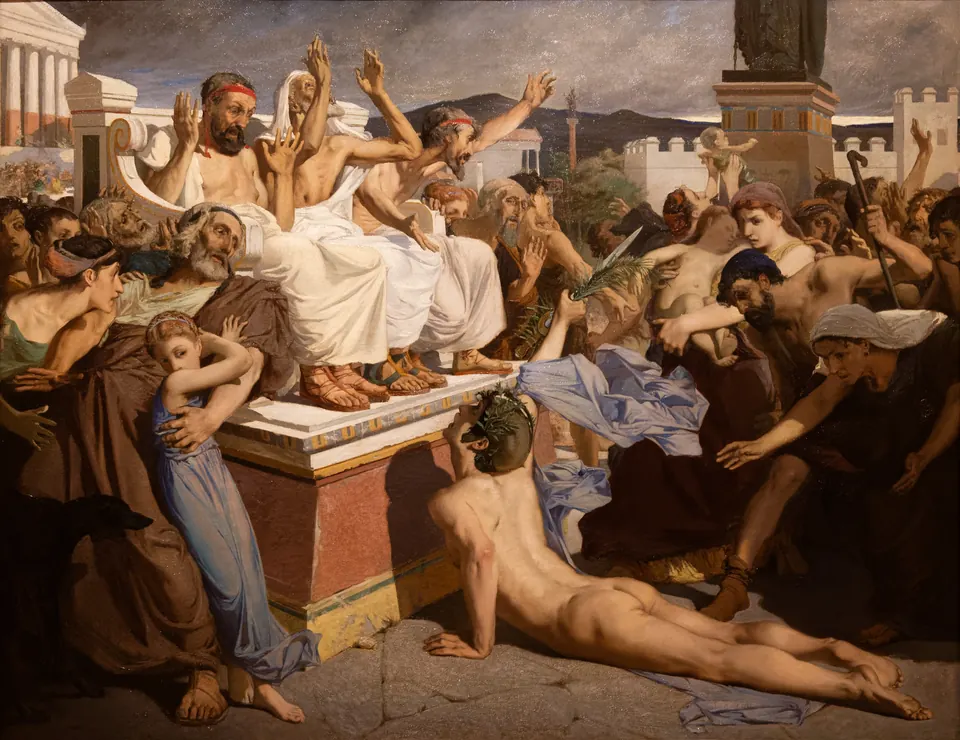
“"Joy, we win!" he said, and died upon his message, breathing his last in the word Joy.”
Lucian, "A Slip of the Tongue in Greeting" (2nd century AD)
Why the Spartans were delayed
Pheidippides appeared before the Spartan magistrates and asked for help, warning that Eretria had already been enslaved and that the most ancient city in Greece risked the same fate. The Spartans resolved to help, but could not do so immediately: it was, per Herodotus, the ninth day of the month, and their law forbade marching to war before the moon was full.
The translator's note on the same passage clarifies that this applied specifically to the month Carneius (Attic Metageitnion), when the Carneia, a festival in honour of Apollo, was celebrated at Sparta from the 7th to the 15th of the month — a religious observance, not a simple bureaucratic delay.
Pan on Mount Parthenion
In the same passage, Herodotus records — explicitly as something Pheidippides himself reported on his return, not as his own narration — that on Mount Parthenion, above Tegea, Pheidippides encountered the god Pan. Pan called him by name and complained that the Athenians neglected him, despite his past and future goodwill toward them.
The Athenians believed the account, and once their affairs prospered they built a shrine to Pan beneath the Acropolis, with an annual sacrifice and torch-race — a cult that, per Herodotus himself, was still observed at the time he was writing.
What Herodotus does NOT say
Reading the whole of chapters 105 and 106 of Book 6, there is no mention of a second run, from Marathon to Athens, to announce the victory. There is no mention of Pheidippides dying. There is not even a mention of him fighting in the battle — Herodotus narrates the Battle of Marathon in the chapters that follow without mentioning his name again.
This is not an argument from silence; it is the complete content of the only contemporary source. Everything that follows below — the second run, the death, the words "We have won" — was added centuries later, by different authors, with different runners' names.
The legend begins: Plutarch and a different runner
The earliest known mention of a run from Marathon to Athens is in Plutarch's "On the Glory of Athens" (Moralia 347C), written around 100 AD — more than five centuries after the battle. Plutarch gives two versions, and neither names the runner Pheidippides: per Heracleides Ponticus (a 4th-century-BC source surviving only in fragments), the news was brought back by Thersippus of Eroeadae; "most historians", Plutarch writes, say it was Eucles, who ran in full armour, straight from the battle, and could only manage to say "Hail! we are victorious!" before he died.
This point matters: the very first text to mention a victory run at all gives two alternative names, both clearly different from Herodotus's Pheidippides. Plutarch even uses the story as a rhetorical example to criticise excessive honours for messengers — suggesting that even he treated it as an illustrative anecdote rather than necessarily a confirmed historical event.
Lucian gives the legend the name Philippides — and the death
The link between the name "Philippides"/"Pheidippides" and the victory run and death first appears in an unexpected text: the satirist Lucian's essay "A Slip of the Tongue in Greeting", written in the 2nd century AD — more than 600 years after the Battle of Marathon. The piece is not a history at all, but an essay on ancient Greek forms of greeting.
Lucian writes that the use of the greeting "Joy" traces back to the dispatch-runner Philippides, who, bringing the news of Marathon, found the archons in suspense over the battle's outcome, said "Joy, we win!", and died on the word "Joy". This is the earliest surviving source to unite, in a single figure, all three elements of the modern legend: the name Philippides, the Marathon-to-Athens run, and the death. Lucian cites no earlier source for the story — he simply tells it as a known local tradition.
Browning (1879) and the 1896 marathon: the legend becomes a sport
In 1879, the English poet Robert Browning published the poem "Pheidippides", which fused the two previously separate ancient narratives into a single story: the same runner first runs to Sparta and back, fights at Marathon, and then runs from Marathon to Athens to die announcing the victory. It is this composite — not any ancient text — that became popular in the late 19th century and was widely accepted by the public as historical fact.
Just seventeen years later, in 1896, French philologist Michel Bréal proposed a running event inspired by the ancient story for the first modern Olympic Games in Athens — a proposal actively backed by the Games' founder, Pierre de Coubertin. The winner of the first Olympic marathon, on 10 April 1896, was Greek water-carrier Spyridon Louis, in 2 hours 58 minutes and 50 seconds — a story bib2bib has already covered in full in its own Spyridon Louis article.
Two modern races, one ancient run
The two halves of the ancient story live on today in two entirely different modern races. The run to Sparta — the one Herodotus actually records — inspired RAF officer John Foden, who in 1982, together with four fellow officers, travelled to Greece to test whether it was feasible to cover the nearly 250 km from Athens to Sparta within 36 hours. Three succeeded; Foden himself finished in 37:37. The following year, 1983, the first official Spartathlon was run, with 44 men and 1 woman from 12 countries — a 246 km race with a 36-hour limit, held every September since (with one exception, 2020). More detail is in bib2bib's own "Spartathlon for beginners" guide Spartathlon for beginners: the complete guide.
The other half of the legend — the victory run of Plutarch and Lucian, from Marathon to Athens — is what inspired the marathon as a sporting event in 1896. Today, the modern Authentic Phidippides Run recombines both halves into a single event: it follows the full Athens-Sparta-Athens route from Herodotus (485.3 km), and this year, in its 10th anniversary edition (19-23 November 2026), it offers for the first time an optional extension on to Marathon (524.9 km total) — "In the Footsteps of the Athenian Army". As bib2bib's own guide to that race already documents, the organiser's own retelling sticks to the Herodotus half only (the run, Pan, no mention of a death) — without citing any ancient source of its own.
Frequently asked questions
Did Pheidippides run from Marathon to Athens?
Not according to Herodotus, the earliest surviving source — he records only a Athens-Sparta-Athens run, before the battle. The Marathon-to-Athens run first appears in Plutarch, more than 500 years later, naming a different runner (Thersippus or Eucles).
Did Pheidippides die after the victory at Marathon?
Herodotus mentions no death at all. The death story, with the words "We have won", first appears in Lucian, in the 2nd century AD, attributed to a runner named Philippides.
How long was the Athens-Sparta route?
Roughly 246 kilometres, per Herodotus, who writes that Pheidippides reached Sparta "the very next day". Isocrates gives the distance as 150 miles.
Why did the Spartans delay helping?
Because of religious law: it was the period of the Carneia, a festival honouring Apollo, during which marching to war before the full moon was forbidden.
Who first wrote about the Marathon-to-Athens run, and which runner does he name?
Plutarch, around 100 AD, in "On the Glory of Athens". He names the runner as either Thersippus (per Heracleides Ponticus) or Eucles (per "most historians") — not Pheidippides.
How is Pheidippides connected to the modern marathon?
Indirectly: the marathon was established in 1896 at the first modern Olympics, an idea of Michel Bréal inspired by the victory-run legend — the same legend Robert Browning had already popularised in his 1879 poem.
Which modern races revive his route?
The Spartathlon (since 1983) revives Herodotus's Athens-Sparta run. The Authentic Phidippides Run revives the same route with a return to Athens, and this year adds an optional extension on to Marathon.