Athens 2004 Olympic Marathon: results and drama
On 22 and 29 August 2004, the Athens Olympics restaged the historic 1896 route from the town of Marathon to the Panathenaic Stadium. On 22 August, Japan's Mizuki Noguchi won the women's marathon in 2:26:20, edging Catherine Ndereba by 12 seconds, after world record holder Paula Radcliffe stopped in tears right at the 36km marker. A week later, on 29 August, Italy's Stefano Baldini won the men's marathon in 2:10:55 — inside the same course's record, held since 1969 — after race leader Vanderlei de Lima of Brazil was shoved off the course by a spectator one hour and 52 minutes into the race; de Lima recovered to take bronze and was awarded the IOC's Pierre de Coubertin medal. Every result, split and quote below is sourced directly to World Athletics' own official results archive and race reports — olympics.com's Athens 2004 pages could not be reached this working session (see the sourcing note at the top of this file).
- 22 Aug 2004, 18:00The women's marathon starts in the town of Marathon, in temperatures above 35°C in the shade.
- 22 Aug 2004, halfwayThe lead group has already thinned from the heat and the climbs; halfway is reached in 1:14:02.
- 22 Aug 2004, 36kmPaula Radcliffe stops right beside the 36km marker and sits down in tears — her Olympic dream ends there.
- 22 Aug 2004Mizuki Noguchi reaches the Panathenaic Stadium first, finishing in 2:26:20, a record for the historic course.
- 29 Aug 2004, 18:00The men's marathon starts; Vanderlei de Lima takes the lead just before the 20km point.
- 29 Aug 2004, 1:52 (~35th-36th km)A spectator shoves the leading de Lima off the course; he loses precious seconds before getting back into his race.
- 29 Aug 2004, 2:00Stefano Baldini passes de Lima and is first into the Panathenaic Stadium, finishing in 2:10:55.
- 29 Aug 2004, closing ceremonyThe IOC awards de Lima the Pierre de Coubertin medal for his sportsmanship.
The course: from Marathon to the Panathenaic Stadium
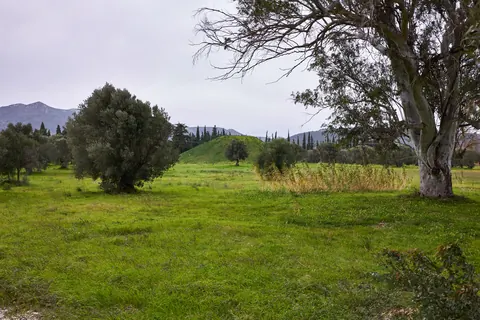
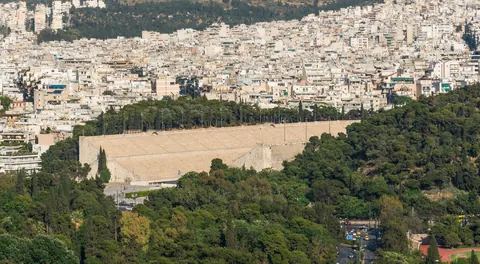
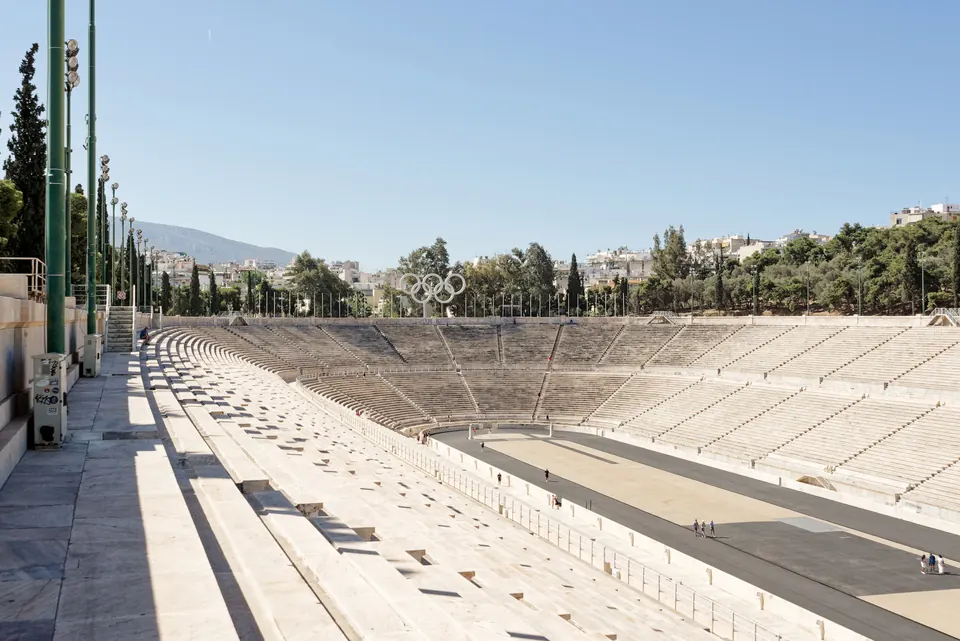
Both Athens 2004 marathons were run on the historic route linking the town of Marathon to the Panathenaic Stadium (the "Kallimarmaro") — the same start and finish as the first modern Olympic marathon in 1896, won by Spyridon Louis. As World Athletics itself puts it in a Heritage feature, the 2004 runners "followed in the footsteps of Pheidippides and Spiridon Louis on the road from Marathon to Athens", finishing at "the magnificent marble Panathinaiko Stadium".
The same source describes the race conditions as "hot and humid ... on a challenging, undulating course" — a description that applies to both the men's and women's races, with temperatures above 35°C in the shade on both days. The course is neither the exact, not fully documented path the ancient messenger is said to have taken, nor precisely the 1896 route by distance — the official 42.195km marathon distance was only fixed in 1908, in London, twelve years after Louis's win.
The men's marathon: Baldini gold in 2:10:55
The men's marathon started on 29 August 2004 at 18:00, with 102 entrants on World Athletics' official results table (81 finished, 20 DNF, 1 DNS). Vanderlei de Lima (Brazil) took the lead just before the 20km point, passed halfway in 1:07:23 with a 15-second lead over a chase pack of nearly two dozen, and at one stage led by as much as a minute and a half. By 35km, with Stefano Baldini, Meb Keflezighi and Paul Tergat looking the best-prepared challengers, de Lima was still 30 seconds clear.
Baldini passed a fading de Lima at 39km and reached the Panathenaic Stadium first in 2:10:55 — a time that, as World Athletics Heritage notes, was "12 seconds inside the Marathon to Athens course record that had been held since 1969 by Bill Adcocks of Great Britain". It made him only the second Italian to win the Olympic marathon title. Meb Keflezighi took silver in 2:11:29 — the USA's first medal in the event since Frank Shorter's silver in 1976 — and de Lima held on for bronze in 2:12:11, despite the incident described in the next section. Jon Brown (Great Britain) finished fourth in 2:12:26, for the second consecutive Olympics.
“It was such a shock, I really wasn't expecting that at all. And I must say that I really couldn't defend myself, I was completely concentrating on the course. Then I had to get back into my competition, which was very, very difficult. Obviously if you stop in the middle of a marathon, it's really really difficult to get your rhythm again.”
Vanderlei de Lima, after the men's marathon (World Athletics, 29 August 2004)
The incident: a spectator shoves leader de Lima off the course
World Athletics' own race report says de Lima "was nearly tackled by a spectator who ran onto the course one hour and fifty-two minutes into the race" — roughly the 35th-36th kilometre, just as his lead had begun to shrink. The spectator shoved him from the middle of the road and into the crowd; de Lima lost precious seconds before he managed to get back into the race. The same report describes the attacker only as "reportedly an Irishman who had disrupted other sporting events in the past, including a Formula One race earlier this year"; a separate World Athletics Heritage feature calls him "a defrocked Irish priest". Neither World Athletics text gives his name, and none is used here.
De Lima himself described the moment: "I couldn't defend myself because I was concentrating on my race. I don't know what would have happened if the Greek man who helped me so quickly (Polyvios Kossivas) hadn't reacted the way he did. I give him a lot of credit for his courage." He added that he struggled to concentrate afterwards, but held on for the bronze medal. Both Baldini and Keflezighi, roughly a hundred metres behind at that point, said they did not see the incident happen.
The women's marathon: Noguchi gold in 2:26:20
The women's marathon started on 22 August 2004 at 18:00; World Athletics' official results table lists 82 runners (66 finished, 16 DNF), while a separate World Athletics race report puts the original entry list at 93. Per World Athletics' detailed race report, Paula Radcliffe (Great Britain), the 2:15:25 world record holder, took the front within minutes of the start. The field soon met "the start of the 13-kilometre-long hill that climbs sharply more than 200 metres into the Athens suburb of [Agia] Paraskevi", and the leading pack of 10 at 15km had thinned to seven by halfway, reached in 1:14:02.
At 25km, Mizuki Noguchi (Japan) executed her coach's plan — "be sure to take all the fluid and make your move at 25km" — attacking at the start of a series of climbs and dropping Elfenesh Alemu. She was 23 seconds clear at 30km and covered the 30-35km stretch in 17:03. Catherine Ndereba (Kenya), the reigning world champion, pursued patiently but started her charge too late, finishing second in 2:26:32, just 12 seconds behind Noguchi. Deena Kastor (USA) ran the fastest closing 5km (35-40km in 16:20) to take bronze in 2:27:20, crossing the line in tears of joy — the USA's first women's Marathon medal since Joan Benoit Samuelson's win twenty years earlier. Noguchi's winning time was, as World Athletics Heritage puts it, "a record on the original marathon course", beating the nine-year-old course record of 2:31:10 held by Anuta Catuna by roughly five minutes.
Paula Radcliffe's collapse at the 36km mark
Radcliffe stayed with the lead group through the 30-32km climbs, but began losing ground as Noguchi pulled away. Alemu passed her first, and per World Athletics' race report, "right beside the 36km marker Radcliffe stopped, in tears. The World record-holder's Olympic dream was over." World Athletics' official results table lists her with a "DNF" status.
A separate World Athletics Heritage feature on Noguchi summarises the collapse this way: Radcliffe, "beset by injury and illness, was unable to respond" to Noguchi's 25km attack, "dropping out at 36km". Neither source gives further medical detail beyond that wording — anything more specific (a named diagnosis, for instance) is not documented on either World Athletics or olympics.com and is not stated here. That evening, nearly a quarter of the field that started failed to finish, because of the heat and the course.
Extreme heat marked both races
Both marathons started at 18:00 local time — a choice that did not spare the runners from the heat. For the women's race, World Athletics describes "more than 35 degrees in the shade" at the start, "around 100 degrees [Fahrenheit]", and "a tough uphill climb to around 35km" in what the same text calls "one of the toughest tests of endurance". The same report notes that the first six finishers all ran faster than the previous course record despite the conditions — a sign of how strong the field was.
For the men's race, World Athletics Heritage describes "hot and humid conditions on a challenging, undulating course". Baldini himself, in a later interview reproduced in that same feature, said growing up in Italy's Po Valley helped him handle "extreme conditions" — "it was my Kenya," he said.
The Pierre de Coubertin medal and the Olympic spirit
At the Games' closing ceremony, the IOC awarded Vanderlei de Lima the Pierre de Coubertin medal — an IOC honour for exceptional acts of sportsmanship, not an event medal. World Athletics describes it explicitly as recognition of "the spirit of fair play and ... the courage he showed" during the incident. De Lima himself, speaking afterwards, did not claim the win he lost: "I don't know if I could have won, but obviously things would have been different. The finish was extremely difficult for me."
The same World Athletics Heritage feature links the incident to an earlier story of sporting injustice in the same event: Italy's Dorando Pietri, who collapsed just short of the finish of the 1908 London marathon and was disqualified for being helped across the line — but was presented with a special cup by Queen Alexandra the next day. "The Olympic marathon has such a big history in Italy," Baldini himself said of the reaction back home, "it is because of Dorando Pietri."
What came after
Despite the gold medal, Baldini ranked only 21st on the 2004 world seasonal list by time — World Athletics notes he was "the only runner in the Olympic top-10 that can be found in the top-40 timewise in 2004", a sign of how much tactics, not just raw speed, mattered in the heat. Radcliffe came back ten weeks later to win the New York Marathon in November 2004, in 2:23:10, according to World Athletics' own end-of-season road review. De Lima told World Athletics immediately after the race that he planned to keep competing, with the 2005 World Championships in Helsinki among his goals.
The Marathon-to-Panathenaic-Stadium route itself was not reused for later Olympic Games in this exact form; it was a one-off choice for the Athens 2004 Games, made precisely to return the marathon to where it began. bib2bib covers the modern Athens Marathon's own course, kilometre by kilometre, and Spyridon Louis's win in the original 1896 race, separately — both are linked below, in the sources.
Frequently asked questions
Who won the men's Olympic marathon in Athens in 2004?
Italy's Stefano Baldini, in 2:10:55, ahead of Meb Keflezighi (USA, 2:11:29) and Vanderlei de Lima (Brazil, 2:12:11), per World Athletics' official results archive.
Who won the women's Olympic marathon in Athens in 2004?
Japan's Mizuki Noguchi, in 2:26:20, ahead of Catherine Ndereba (Kenya, 2:26:32) and Deena Kastor (USA, 2:27:20).
What happened to Vanderlei de Lima during the race?
While leading, a spectator shoved him off the course one hour and 52 minutes into the race (around the 35th-36th km). He lost time and his lead, but recovered to hold on for the bronze medal.
Who attacked de Lima?
World Athletics describes him only as "reportedly an Irishman" who had disrupted other sporting events, and elsewhere as "a defrocked Irish priest" — neither mention gives his name. His identity is not documented in either of this article's two sources, so it is not stated here.
Why did Paula Radcliffe drop out?
She stopped right at the 36km marker, "beset by injury and illness", per World Athletics — this article's sources give no further medical detail.
What was the Athens 2004 marathon course?
From the town of Marathon to the Panathenaic Stadium — the same start and finish as the first modern Olympic marathon, in 1896.
Did de Lima still win a medal?
Yes, bronze (2:12:11), and he was also awarded the IOC's Pierre de Coubertin medal at the closing ceremony for his sportsmanship.
What was the previous course record before Athens 2004?
For the men, a time described by World Athletics as a 1969 course record held by Britain's Bill Adcocks, which Baldini beat by 12 seconds. For the women, 2:31:10, held by Anuta Catuna for nine years, which Noguchi beat by roughly five minutes.