Taygetos Challenge 2027: race guide
The 16th Taygetos Challenge is scheduled for the two-day weekend of Saturday 27 and Sunday 28 March 2027, from Kardamyli in Western Mani, Messinia — according to a Runner Magazine announcement dated 23 March 2026, currently the only source giving that specific 2027 date. It is one of the races bib2bib itself names among the country's four biggest mountain trail races — third in that list, after Zagori Mountain Running and the Sfakia Sky Marathon — and the race with the longest documented history (16 editions, with a two-year pause for COVID-19) among those that did not yet have their own bib2bib guide. It stands out for its two-day format — Vertical Speed on Saturday, four distances (5, 10, 22 and 40 km) on Sunday — and for the mountain standing almost invisibly behind a coastline known internationally in a very different context: Kardamyli is the village where the English writer Patrick Leigh Fermor spent his later years, and where he was made an honorary citizen for his role in the Greek Resistance. Below is the race format, the distances, the schedule as it ran at the most recent (15th) edition, the event's history, and exactly what is not yet known about 2027.
What the Taygetos Challenge is
The Taygetos Challenge is a two-day mountain-running event based in Kardamyli, Western Mani, Messinia — the 16th edition's own announcement explicitly calls it a "two-day event", Saturday 27 and Sunday 28 March 2027. It is not a single-course race but a package of five events: a vertical-speed race (Vertical Speed) on Saturday, and four distances — 5, 10, 22 and 40 kilometres — on Sunday, per the schedule of the most recent (15th) edition on the official site, taygetoschallenge.com.
What makes the two-day format more than a scheduling convenience is the scoring: the overall Taygetos Challenge winner is not simply the fastest finisher of one distance, but is decided by combined placement points from Saturday's Vertical Speed and one of the three Sunday distances (Marathon, Experience or Basic) — this is stated explicitly on the race's own "Terms of Participation" page. Entering the Vertical Speed is mandatory for anyone who wants an official overall Taygetos Challenge ranking, with one exception: Fun 5km entrants, for whom the Vertical Speed is optional and is not counted at all.
The mountain behind Kardamyli: Taygetus
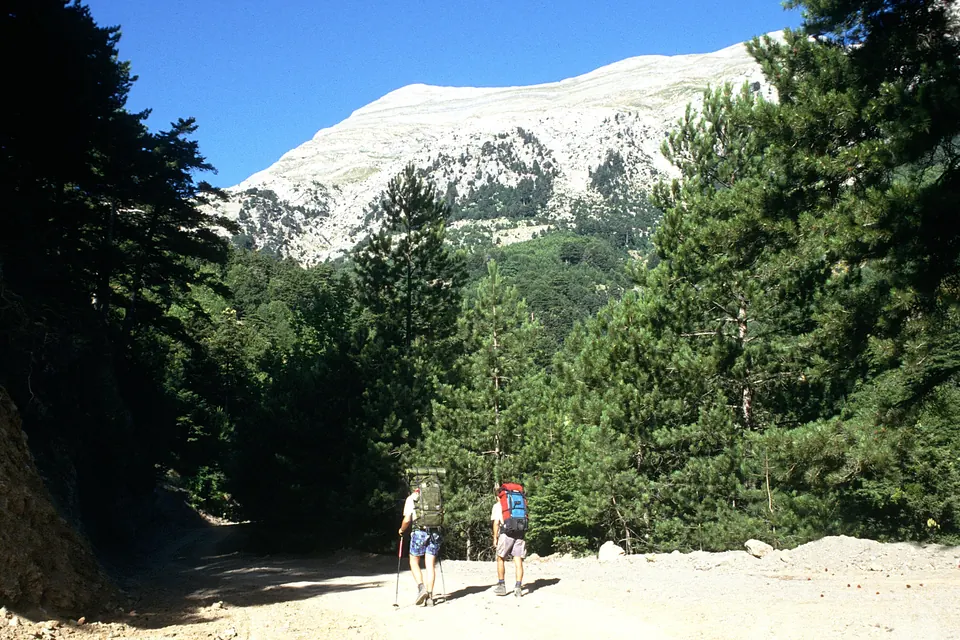
The race runs on Taygetus, the highest mountain range in the Peloponnese — the race's own site gives its peak, Profitis Ilias, as 2,407 m, while the exact elevation is reported differently depending on the source (2,404-2,407 m). That cross-source discrepancy is already analysed in detail in bib2bib's own trail-running guide, and is not repeated here — /en/articles/trail-running-greece-guide.
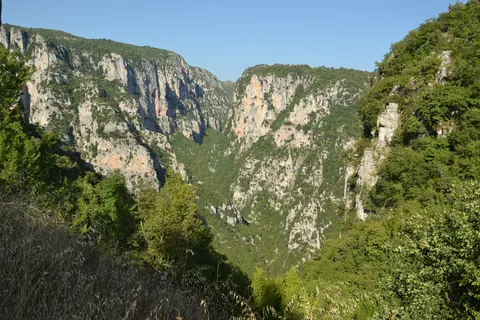
Two details from the race's own site are worth flagging here, since they are not repeated elsewhere on bib2bib: the area is designated a European-level "Special Protection Zone" (Natura 2000, code GR2550009, "Mount Taygetus-Lagkada Tripis"), home to 32 protected bird species including the golden eagle, and two-thirds of the race's trails run inside that protected zone. Part of the course follows the Viros Gorge, which — beyond its natural beauty — carried historical weight as the route of the ancient Royal Road connecting Sparta to the port of Kardamyli, while the crossing of the Doubitsia plateau, part of the course since 2013, sits inside a designated Wildlife Refuge.
The distances: five events, two days
- Vertical Speed — 650 m long, +150 m of elevation gain, Saturday afternoon; starts released in groups of 5 runners per minute at the most recent edition
- HANSAPLAST Marathon 40km — about 40 km and 2,504 m of elevation gain per the official site; historically the race's "main" distance, run as 37 km at the 2010 founding
- AQUARELLA Experience 22km — 1,224 m of elevation gain; the distance's own info box states "Course length: 23km" even though its official name is "22KM" — a discrepancy left unresolved on the official site itself
- NIVEA SUN Basic 10km — introduced in March 2022; elevation gain is stated as either 460 m (in the course description) or 500 m (on the "Terms of Participation" page) — another discrepancy on the official site itself, reported here rather than arbitrarily "corrected"
- Fun 5km — elevation gain stated as either 150 m (page footer) or 201 m (on the distance's own page); the only distance where Vertical Speed is not mandatory for the overall ranking
Age categories and awards
The three larger distances (Marathon, Experience, Basic) share the same eight age categories for men and women — M1/W1 (18-35), M2/W2 (36-49), M3/W3 (50-59), M4/W4 (60+) — while Fun 5km has a single category per gender, 18 and over, per the "Terms of Participation" page. For an age category to "count" officially, at least 6 finishers are required; otherwise it is merged into the next category down.
Minors may only enter the Fun distance, accompanied by a parent and with a signed guardian consent form, per the same page.
The three-day schedule: as it ran at the 15th edition (2026)
The official site has not yet published a schedule for the 2027 edition. The following is the schedule of the most recent, 15th edition (20-22 March 2026), as posted on the site's "Race Programme" page. If the same pattern holds, something similar is expected for 2027, but this has not yet been confirmed by the organiser.
- Friday afternoon: race-number pickup at the old school building below Kardamyli's main square
- Saturday 13:30: Vertical Speed technical briefing · 14:00: Vertical Speed start (groups of 5, one group per minute) · 18:00: kids' race · 19:00-21:00: free pasta party for entrants
- Sunday 08:00: Marathon 40km and Experience 22km start, Kardamyli's main square · 08:15: Basic 10km and Fun 5km start
- Sunday 13:00: course cutoff ("gate") at the Viros Gorge, around the 20-21 km mark — for the 40 km distance only — before the climb into Doubitsia
- Sunday 17:00: overall cutoff for valid finishes (9 hours after the start) · 16:00: age-category award ceremony
Registration, cost and course cutoffs
The only source stating a specific entry fee is the "Terms of Participation" page, which — as checked on 29 September 2026 — was still written for the 14th edition (22-23 March 2025), not for 2026 or 2027: €50 for Vertical + Marathon, €30 for Vertical + Experience, €20 for Vertical + Basic, €15 for Fun. The fee stays the same whether or not an entrant also runs the Vertical Speed. Because this page has not been updated, these figures are reported here as historical data, not as the current 2027 price.
The only course cutoff is on the 40 km distance (the gate at the Viros Gorge, around the 20-21 km mark) and the overall 9-hour limit from the start; the other three distances carry no cutoff, per the same page. No mandatory gear is stated — only a recommendation, not a requirement — while poles, a map, a compass, GPS and a mobile phone are all permitted, and outside assistance or drafting between runners is prohibited.
16 years of history: from 2010 to 2027
The race was founded in 2010 by 2407 Mountain Activities, with Nikos Kostopoulos as technical director; its first edition included a 37 km Marathon (2,100 m of elevation gain) and the 650 m Vertical Speed, per the organiser's own timeline. In 2014 it adopted the official name "Taygetos Challenge" and joined the Greek Skyrunning Championship as the season's opening race. In 2019, its 10th anniversary, it set a record of 593 entrants.
The COVID-19 pandemic forced a postponement for two consecutive years (2020-2021). The 2022 return — which the organiser itself describes as the "10+1 years" mark — drew roughly double the 2019 field, introduced the 10 km distance, and, per the organiser's own timeline, saw local athlete Nikos Ponireas set a new course record on what was then the 20 km Experience distance — a claim made by the organiser itself, not independently verified here. In 2024, Hansaplast became the exclusive sponsor of what was by then a 40 km Marathon, with a refreshed route through Kalyves and the Viros Gorge. The official site's narrative timeline stops at 2024; the 15th edition (2026) is documented only through a "15 YEARS" anniversary framing and a commemorative "Anthrax" technical T-shirt, with no separate narrative entry of its own.
Kardamyli: why it is known beyond Greece
Kardamyli is a seaside village in Western Mani, about 35 km from Kalamata, with stone towers and Byzantine churches, per the race's own site. The same site states, as a tradition drawn from Homer, that Kardamyli was one of seven cities Agamemnon offered Achilles in the Iliad — an invocation of legendary tradition by the organiser, not a verified historical event. Later, better-documented history: after the Battle of Leuctra (371 BC) the area passed to the Messenians, from the 17th century it is linked to the Palaiologos-Troupakis family, and on 6 January 1821 Theodoros Kolokotronis arrived there from Zakynthos and was hosted at the tower of Panagiotis Troupakis, organising from there the capture of Kalamata.
Kardamyli's international fame, however, was built elsewhere: the nearby village of Kalamitsi was the home, in his later years, of the English writer Patrick Leigh Fermor and his wife Joan, who was made an honorary citizen of Kalamitsi (not of Kardamyli itself) for his role in the Greek Resistance during World War II — per the English-language Wikipedia. The ashes of writer Bruce Chatwin were scattered near a Byzantine chapel above the village in 1989. This connection to internationally known writers is why Kardamyli functions as a reference point for foreign visitors long before any mountain race existed there — a surprise mountain behind an already-famous coast, not the other way around.
What is not yet known about 2027
Beyond the two dates (27-28 March 2027) and the five events, the Runner Magazine announcement explicitly states that "more information is expected". As of the 29 September 2026 check, the official site had not yet published: an exact 2027 route or elevation figures, a start-time schedule, an entry fee, registration deadlines, or a live registration page for the 16th edition — every figure above concerns only the 15th (2026) or 14th (2025) edition. Anyone planning to enter in 2027 should check taygetoschallenge.com directly before booking travel or accommodation.
Frequently asked questions
When is the 16th Taygetos Challenge 2027?
Saturday 27 and Sunday 28 March 2027, in Kardamyli, Western Mani — per a Runner Magazine announcement dated 23 March 2026. The race's own official site had not yet been updated with this date as of the 29 September 2026 check.
What distances does the race offer?
Five: Vertical Speed (650 m) on Saturday, and Fun 5km, Basic 10km, Experience 22km and Marathon 40km on Sunday, per the 16th edition's announcement.
How is the overall Taygetos Challenge winner decided?
By combined placement points from Saturday's Vertical Speed and one of the three Sunday distances. Entering the Vertical Speed is mandatory for the overall ranking, except for Fun 5km entrants.
How much will it cost to enter in 2027?
Not yet known. The only published price (€50/€30/€20/€15 depending on distance) sits on a page that, as of the 29 September 2026 check, was still written for the 2025 edition.
Is there a course cutoff?
Only for the 40 km distance: a gate at the Viros Gorge (around the 20-21 km mark) at 13:00, and an overall 9-hour limit from the start, per the official site (data from the 14th/15th editions). The other distances have no cutoff.
How long has the event existed?
Founded in 2010; 2027 is the 16th edition, with a two-year pause (2020-2021) for COVID-19, per the organiser's own timeline.
Why is Kardamyli known to foreign visitors?
Because it was the home, in his later years, of English writer Patrick Leigh Fermor, who was made an honorary citizen for his role in the Greek Resistance — per the English-language Wikipedia.